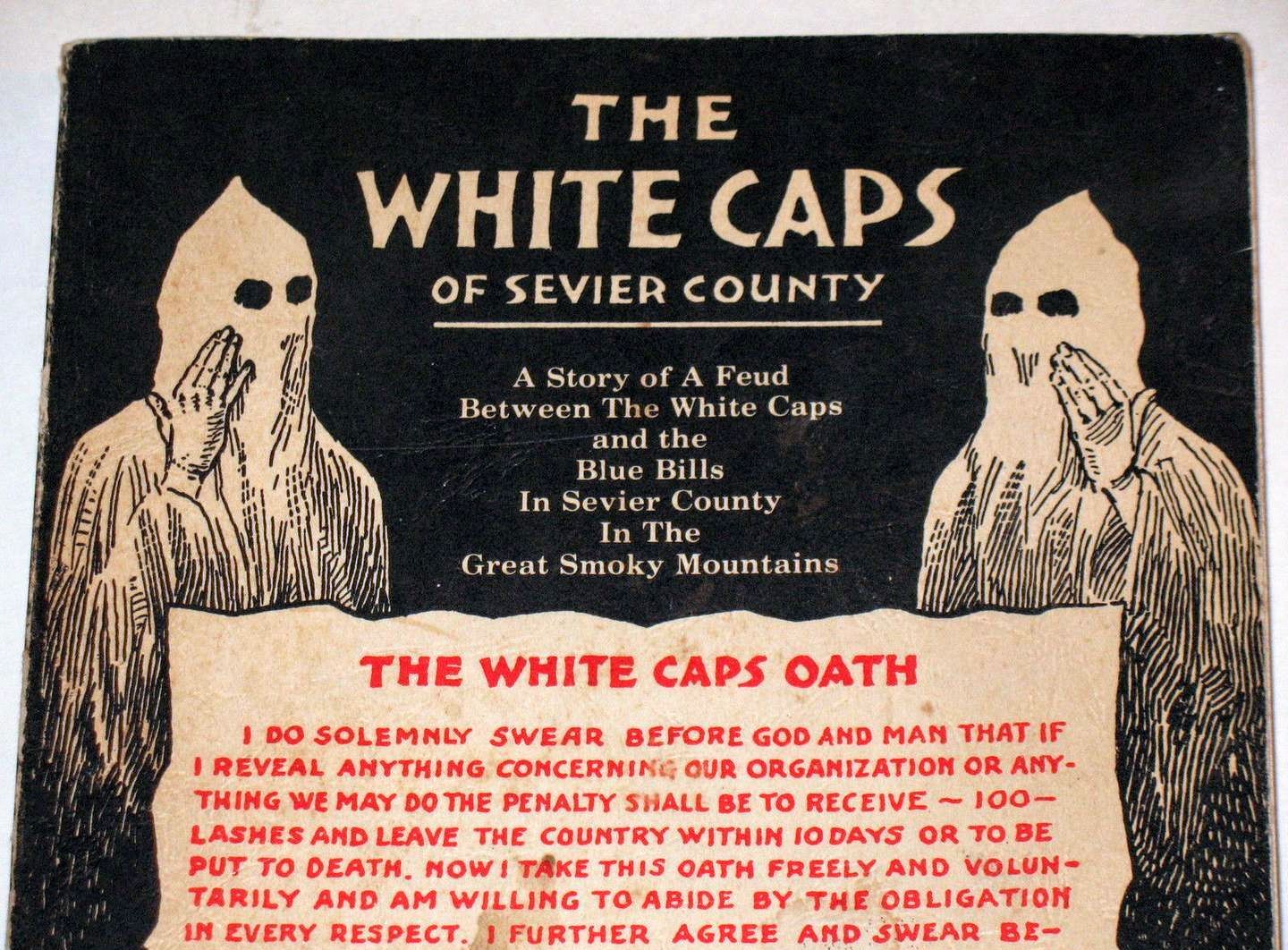
A Disturbing History of the White Cap Movement
It is a common misconception that 19th-century vigilantism was a monolith. While the Ku Klux Klan dominates our collective memory, a distinct and perhaps more insidious movement—Whitecapping—once held the American rural landscape in a grip of terror. It did not begin with grand political ambitions; it started as a "neighborhood watch" that traded its moral compass for a whip.
Tracing this history reveals how a community’s fear of change can be weaponized into a system of shadow justice.
The Indiana Method: The Birth of "Moral" Terror
The movement found its footing in the late 1880s among the rugged hills of Southern Indiana. These original White Caps did not view themselves as criminals; they believed they were the "conscience" of a decaying society. They targeted individuals they considered "social parasites"—men who drank away their wages, neglected their families, or refused to work.
The "Indiana Method" was a chillingly effective blueprint for psychological warfare. It was not enough to punish the "offender"; the community had to be made a witness. The process began with a formal warning—a bundle of switches or a cryptic note left on a porch. If the individual did not "reform" or flee, they faced a midnight visitation from masked men who administered the "hickory treatment." This ritualized violence was a desperate attempt to force Victorian-era standards of decency upon a changing frontier.
Sabotage and the Agrarian Revolt
As the 1890s approached, the movement underwent a metamorphosis. The focus shifted from the bedroom and the tavern to the fence line and the railroad track. Economic anxiety, fueled by a national depression, turned Whitecapping into a weapon of the dispossessed.
In New Mexico, the movement took the form of Las Gorras Blancas (The White Caps). Here, Hispano farmers donned the mask to protect their ancestral lands from being swallowed by railroad tycoons and Anglo speculators. They were not moralizing; they were sabotaging. By cutting miles of barbed wire and burning railroad ties, they utilized the White Cap identity to wage a guerrilla war against industrial expansion. In the South, similar groups targeted "Fence Laws," fighting to keep the open range accessible for the poor.
The Racial Pivot and the Business of Exclusion
The darkest chapter of this history unfolded as Whitecapping migrated to the Deep South. Here, we witness the Racial Pivot. The "Indiana Method" was no longer used to punish moral failings; it was used to crush economic competition.
In places like Lincoln County, Mississippi, white tenant farmers feeling squeezed by the planter's elite, and the rising efficiency of Black laborers turned the mask toward their neighbors. This was "white capping for profit." Successful Black farmers were targeted precisely because of their industriousness. "Clearing runs" became common, where masked men would force Black families to abandon their homes and harvests overnight. It was a systematic effort to ensure that the limited resources of the South remained a white monopoly.
The Tenant War and Institutional Absorption
By 1902, the social fabric of Lincoln County was completely unraveled. The White Caps became so entrenched that they established "Whitecap Courts," deciding which Black families were "allowed" to stay, and which white landowners were "guilty" of hiring them. This eventually led to an insurrection against the economic order itself, as White Caps began burning the property of the wealthy white elite who dared to hire Black labor.
The state finally intervened, not out of a sense of justice, but to protect capital. Stringent Anti-Whitecapping Acts were passed, making it a felony to commit a crime while disguised. However, the movement did not disappear; it was merely "rebranded." When the Second Ku Klux Klan was formed in 1915, it absorbed the White Caps' DNA—the focus on "traditional values," the use of the mask to enforce social codes, and the weaponization of economic envy.
Author’s Note: The Echoes of the Mask
It is easy to relegate the White Caps to the dusty shelves of "frontier curiosities," yet their story remains uncomfortably relevant. The movement was born of a cocktail of ingredients we still recognize: a deep-seated distrust of central institutions, the anxiety of a workforce left behind by industrial shifts, and the dangerous belief that "community standards" justify suspending the law.
The White Caps remind us that vigilantism is rarely about absolute justice; it is about the anxiety of control. By studying this history, we do not just document past crimes—we learn to recognize the early warning signs of when a community begins to prefer the "shadow court" over the rule of law.
Research Dossier & Citations
- Social & Psychological Profile: The Indiana Magazine of History: The White Cap Phenomenon
- The Land Rights Conflict: University of New Mexico: The Heritage of Las Gorras Blancas
- The Lincoln County Case Study: Mississippi Department of Archives: Governor Longino and the Rule of Law
- The Evolutionary Bridge: The National Archives: From Regulators to the 20th Century Klan