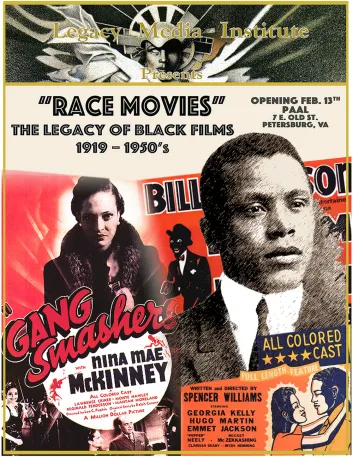
The “Birth of Race Movies” 1915 - 1950s
The history of American cinema is often told through the lens of Hollywood’s Golden Age—a sparkling era of technicolor musicals and noir thrillers. However, bubbling beneath that mainstream surface was a parallel universe of filmmaking born out of necessity, defiance, and a desperate need for representation. From 1915 through the early 1950s, Race Movies provided a vital mirror for Black audiences in an era when the dominant culture ignored or ridiculed them.
These were not just "movies with Black actors." They were a cultural movement that challenged the status quo, creating a blueprint for independent filmmaking that still resonates today.
The Catalyst: Defiance in the Face of Derision
The year 1915 marks a pivotal—and painful—moment in cinematic history. D.W. Griffith released The Birth of a Nation, a film that revolutionized filmmaking techniques while simultaneously glorifying the Ku Klux Klan and dehumanizing Black Americans through grotesque stereotypes and blackface.
While the NAACP protested in the streets, a group of Black entrepreneurs and creatives decided that the most effective counter-protest was creation. If Hollywood were going to weaponize the screen, they would use the same medium to humanize the Black experience. This birthed the Race Movie industry: films produced specifically for Black audiences, often featuring all-Black casts, and distributed through a segregated network of theaters.
The Pioneers of the Independent Spirit
The early years of Race Movies were defined by a "by any means necessary" ethos. Production companies like the Lincoln Motion Picture Company, founded in 1916 by actor Noble Johnson, were among the first to portray Black people as more than servants or comic relief. However, no name looms larger over this era than Oscar Micheaux.
The Legend of Oscar Micheaux
Micheaux was the ultimate "hyphenate" before the term existed. A former Pullman porter and homestead farmer, he became a novelist and then a filmmaker to bring his stories to life. His hustle was legendary:
- The Funding: He would travel from town to town, selling stock in his films to Black farmers and businesspeople.
- The Distribution: He often hand-delivered film canisters to theaters, staying long enough to watch the premiere before moving to the next city.
- The Vision: His 1920 film, Within Our Gates, was a direct, searing rebuttal to Griffith’s racism, depicting the harsh realities of Jim Crow and lynching with a frankness Hollywood would not touch for decades.
Challenging the "Casting Couch" of Stereotypes
Hollywood’s treatment of Black talent in the early 20th century was confined to narrow, often offensive archetypes: the "Mammy," the "Uncle Tom," or the "Sambo." Race Movies shattered these tropes by presenting a multidimensional Black society.
The "Talented Tenth" on Screen
Reflecting the aspirations of the era, many Race Movies focused on the middle and upper classes. Audiences saw Black doctors, lawyers, detectives, and romantic leads. These films dealt with "internal" community themes that were invisible to white audiences, such as:
- Class Tensions: The divide between the rural poor and the urban "New Negro."
- Colorism and "Passing": The complex social dynamics of light-skinned individuals attempting to navigate a segregated world.
- Educational Ambition: The drive for self-improvement and the value of HBCUs (Historically Black Colleges and Universities).
By showing Black characters in positions of authority and grace, Race Movies acted as a form of social activism, reinforcing a sense of dignity that the "Jim Crow" world outside the theater sought to strip away.
The "Midnight Rambles": A Segregated Cinema Culture
Because of segregation, the consumption of these films was as unique as their production. In the South and Northern cities, Black audiences were often relegated to white-owned theaters' balconies. However, many theaters hosted "Midnight Rambles"—special midnight screenings specifically for Black patrons, where Race Movies could be shown without white audiences.
This created a communal experience. For a few hours, the screen did not belong to the "white world." It was a space where Black joy, sorrow, and heroism were center stage.
The Sound Era and the Rise of Genre
When "talkies" arrived in the late 1920s, the Race Movie industry did not falter; it diversified. The 1930s and 40s saw the emergence of Black-centric genre films:
- Westerns: Herb Jeffries, known as the "Bronze Buckaroo," starred in films like Harlem on the Prairie, giving Black children a cowboy hero who looked like them.
- Musicals: Films like The Blood of Jesus (1941) blended folk religion with surrealist imagery, becoming one of the most financially successful Race Movies ever made.
- Crime Thrillers: Urban dramas reflected the "Great Migration" experience, trading the rural South for the gritty streets of Harlem or Chicago.
"Race movies were the only place where a Black man could be a hero without having to ask for permission."
The Decline and the Legacy of Integration
The decline of the Race Movie industry in the late 1940s and early 1950s is a bittersweet chapter. Several factors led to its end:
- The End of the War: After WWII, Black veterans returned home demanding the same rights they fought abroad, leading to the early stirrings of the Civil Rights Movement.
- Hollywood’s Shift: Seeing the profitability of Black audiences, Hollywood began to integrate Black stars into "prestige" films (e.g., Pinky or No Way Out). While this provided better production values, it often lacked the independents' raw, community-focused view.
- Financial Constraints: Small independent companies simply could not compete with the massive marketing budgets and technical polish of the major studios.
By the mid-1950s, the era of the Race Movie was over. But their impact was permanent. They proved that there was a massive, underserved market for Black stories—a lesson that would eventually pave the way for the Blaxploitation era of the 70s and the "Black New Wave" of the 90s.
Why They Matter Today
Many Race Movies were lost to time due to poor storage and the fragility of nitrate films. However, the ones that remain are more than just historical curiosities; they are a testament to creative resilience.
Directors like Oscar Micheaux and performers like Dorothy Dandridge or Paul Robeson (who often moved between Race Movies and the mainstream) were the architects of a cinematic language that did not wait for "inclusion." They built their own house after being barred from the mansion.
Today, when we see directors like John Singleton, Ryan Coogler, Spike Lee, and Antoine Fuqua commanding the box office, they are standing on the shoulders of the independent pioneers who, with little more than a camera and a dream, insisted that their lives were worthy of the silver screen.
To dive deeper into the world of Race Movies, here is a curated list of the most influential films from that era, along with the best platforms to watch them on in 2026.
1. Within Our Gates (1920)
- Director: Oscar Micheaux
- The Plot: A young woman travels North to raise money for a rural school for Black children, uncovering a traumatic family past tied to lynching and racial injustice.
- Significance: It is the oldest surviving film by a Black director and serves as a powerful, unflinching rebuttal to The Birth of a Nation.
2. The Blood of Jesus (1941)
- Director: Spencer Williams
- The Plot: A spiritual drama where a woman’s soul hangs in the balance between Heaven and Hell after a tragic accident.
- Significance: Made on a tiny budget, it became a massive commercial hit and is considered one of the most successful Race Movies ever produced.
3. The Bronze Buckaroo (1939)
- Director: Richard C. Kahn
- The Plot: A classic Western starring Herb Jeffries as a singing cowboy who seeks justice for a murdered friend.
- Significance: It challenged the "white-only" narrative of the American frontier and gave Black audiences their own matinee hero.
4. Body and Soul (1925)
- Director: Oscar Micheaux
- The Plot: Paul Robeson makes his film debut in a dual role, playing both a virtuous man and a corrupt, "false" minister.
- Significance: This film highlighted the early genius of Robeson and explored complex internal themes of faith and exploitation within the community.
5. Dirty Gertie from Harlem U.S.A. (1946)
- Director: Spencer Williams
- The Plot: A loose adaptation of Somerset Maugham’s "Rain," focusing on a cabaret performer who flees her past in Harlem for a resort in the Caribbean.
- Significance: It represents the later era of Race Movies that leaned into the noir and "fallen woman" genres.
Where to Stream Them (2026)
Most of these films are now in the public domain, but "restored" versions are much easier to watch. Here are the best places to find them:
Platform
What to Look For
Cost
The Criterion Channel
Search for the "Pioneers of African American Cinema" collection. This is the gold standard for restoration.
Subscription
Black Film Archive
A massive digital register that links to streaming versions of Black films from 1898–1999.
Free (Index)
Kanopy
Available through many public libraries and universities, it features many Oscar Micheaux restorations.
Free (with Library Card)
YouTube / Internet Archive
Since many are in the public domain, you can find raw (non-restored) versions for free here.
Free
Kino Film Collection
Often available as an add-on channel (Prime Video/Apple TV); houses the best-restored masters.
Subscription/Rental
To deeply appreciate the evolution of early Black cinema, exploring the filmography of Oscar Micheaux is essential. He was not just a director; he was a novelist, a producer, and a relentless promoter who often adapted his own books into films.
Watching his work in a specific order helps you see how he moved from raw, urgent social commentary to more polished, genre-bending narratives despite working with almost no budget.
Phase 1: The Social Revolutionary
Start here to understand Micheaux’s core mission: rebutting white supremacy and depicting the "New Negro" of the 1920s.
- Within Our Gates (1920): his most important work. It was a direct response to the racism of The Birth of a Nation. It deals with lynching, the Jim Crow South, and the struggle for Black education. It is raw, non-linear, and incredibly brave for its time.
- The Symbol of the Unconquered (1920): Watch this next to see Micheaux tackle the Ku Klux Klan directly. It is a story about a land dispute involving oil, highlighting Black land ownership—a theme close to Micheaux's heart as a former homesteader.
Phase 2: The Silent Master & The Star Maker
In this phase, you see Micheaux using his platform to launch major talents and explore internal community tensions.
- Body and Soul (1925): This film features the screen debut of the legendary Paul Robeson. Robeson plays dual roles: a benevolent man and a corrupt, predatory "preacher." It is a fascinating look at how Micheaux was unafraid to critique institutions within his own community, such as the church.
Phase 3: Navigating the Sound Era
As technology shifted to "talkies," Micheaux had to adapt his "guerrilla filmmaking" style to include audio, which was expensive and technically difficult for independent studios.
- Murder in Harlem (1935): This is a notable example of Micheaux’s transition into the "detective" and "noir" genres. It is based on a real-life murder case but flipped the script to show a Black man being framed and a Black lawyer defending him.
- Lying Lips (1939): One of his more polished later works. It is a classic "wrongly accused" mystery that leans heavily into the nightclub culture of the era, showing the glamour and the grit of urban life in the late 30s.
Phase 4: The Final Act
- The Betrayal (1948): This was Micheaux’s final film and his attempt at a "comeback" in the post-WWII era. It was 3.5 hours long and extremely ambitious. While only fragments and records of its impact remain, it represents the end of an era before Hollywood began to absorb Black talent into the mainstream.
Pro-Tips for Watching
- Context is Key: Remember that Micheaux often could not afford "second takes." If you see a technical error (a boom mic or a flubbed line), look past it to the narrative intent.
- Musical Scores: Many silent versions you find today have modern scores added. Try to find the versions restored by the Library of Congress or Kino Lorber for the most authentic experience.
- The "Micheaux Style": Look for his use of cross-cutting between different time periods—he employed complex storytelling techniques long before they became standard in Hollywood.
You can view "Within Our Gates" (1920) for free through several reputable digital archives. Because it is in the public domain and recognized as a work of immense cultural importance, it has been preserved by several major institutions:
Opens in a new window www.austinfilm.org
- The Library of Congress hosts a digital version of the film as part of its National Film Registry. This is often considered the most "official" digital copy available.
- The Internet Archive: A reliable source for viewing the film in its entirety. It is often paired with various scores because the original silent-film music was lost.
- YouTube (via BFI or Public Domain Channels): The British Film Institute (BFI) and various academic channels have uploaded high-quality transfers of the restored print.
Viewing Tip: Look for the version restored by the Library of Congress. In the 1990s, a print of the film (titled La Negra) was discovered in Spain, allowing historians to reconstruct the film after it had been thought lost for decades.
Watching this film today is a powerful experience, as it provides a rare, unvarnished look at the social landscape of the 1920s from a perspective that was intentionally suppressed for a long time